

US tariffs have jolted Canada into a new geopolitical reality. As Prime Minister Carney rightly emphasizes, great powers now weaponize deep integration, once a strength, to extract concessions from smaller partners.
But deep integration itself is not the problem. The problem is depending on a single partner that is no longer reliable. Our over-reliance on American exports stems from supply chains built around one market. Durable trade diversification means pursuing the same deep integration with multiple, reliable middle power partners, embedding Canadian firms in production networks so that one-time purchases become lasting export relationships.
That takes two policies working as one. Industrial policy scales up Canadian firms in strategic sectors so they can produce competitive products. Trade policy opens global markets so those firms can export them. Neither works well alone.
To do both well, policy makers and industry must know where to look. Interest in the question is gaining momentum (IRPP, 2026), and we built Canada’s Future Alliance Trade Explorer to provide an evidence base for this critical discussion.
The Explorer covers 33 allied economies, plus the European Union as single importer alongside its member states, and shows where the Canada has untapped potential to raise its share of what allies buy, from whole sectors down to individual products.1
Choosing our partners
How should Canada think about new partnerships and alliances in global trade? To enhance resilience in industrial supply chains, Canada needs to identify like-minded countries that have important capabilities. With the increasing economic and strategic importance of electric technologies, Japan and South Korea are critical partners. They have the strongest industrial base in semiconductors, batteries, and grid equipment.
Europe, which has been the focus of much recent discussion, offers strong complementarities in critical minerals, semiconductors, aerospace, automobiles, batteries, and grid equipment.
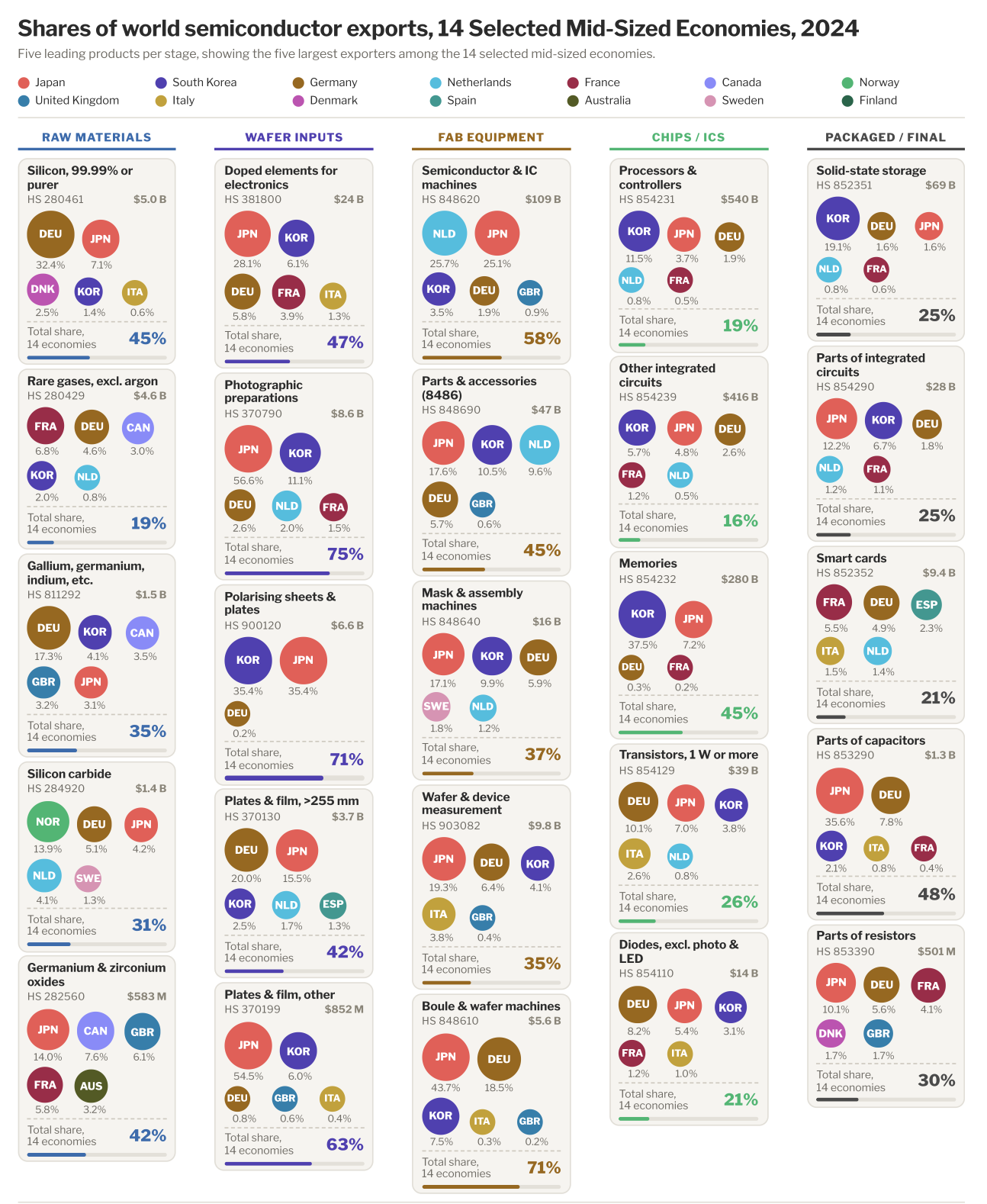
As an example, the chart below shows the importance of different mid-sized trade economies across key components of the semiconductor supply chain. Canada offers some complementarities at the raw materials stage, particularly for some metals and oxides, as well as necessary noble gases. The importance of Japan and South Korea to all subsequent stages is clear, supplemented by important positions occupied by Germany, the Netherlands, France, Italy, Denmark, and the UK.
From Canada’s complementarities to opportunities
“Where our strengths differ, they complement. Where they overlap, they create scale. We should build on each other’s strengths – deliberately, systematically, and rapidly.” Prime Minister Mark Carney
The Future Alliance Trade Explorer helps make the jump from complementarities to opportunities with like-minded allies.
Key terms included in this analysis include:
- Untapped gap — a country’s total imports minus what Canada supplies — the part of that market going to someone else.
- Canadian share — the share of a country’s imports provided by Canada.
- Market growth — the change (increase or decrease) in a country’s total imports of the product between 2017 and 2024.
The tool is designed to locate untapped export market gaps. These gaps represent opportunities in products where Canada has demonstrated export capabilities and partners have large import markets, but Canadian exports remain limited.
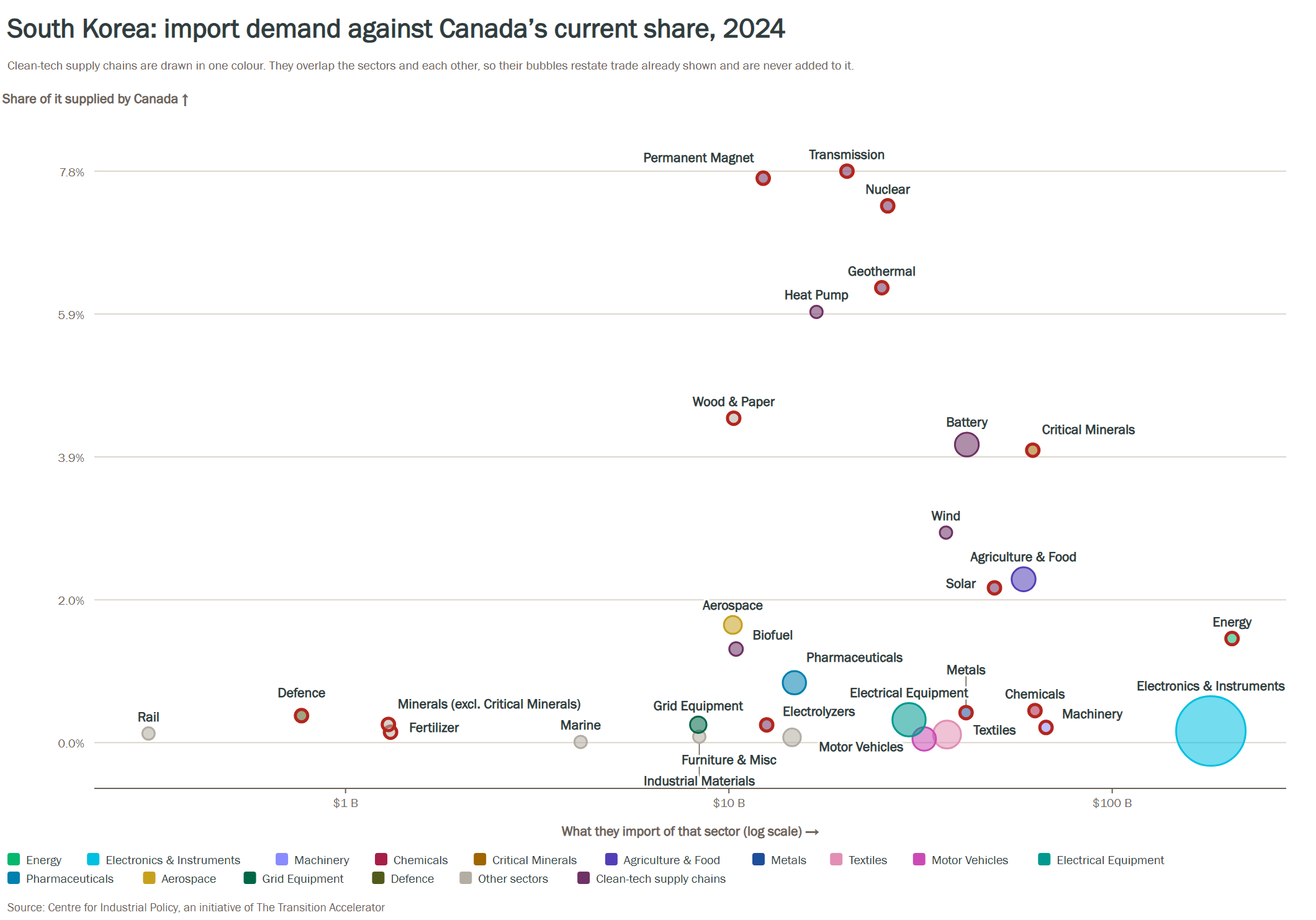
Users can explore data by sector, selected supply chains, and products. Take the example of South Korea: at a broader level, overall trade with Canada can be summarized by economic sector, represented by the coloured bubbles. The view shows how much the trading partner imports of that sector (horizontal axis), and what share of that comes from Canada (vertical axis). Bubble size shows how much the entire import market of that sector has grown since 2017. The size is the scale of the growth and a red ring marks a sector whose market shrank instead. The bottom right corner is where the trading partner imports a great deal and Canada supplies almost none of it. Canada should assess whether it can move these sectors to the top right corner.
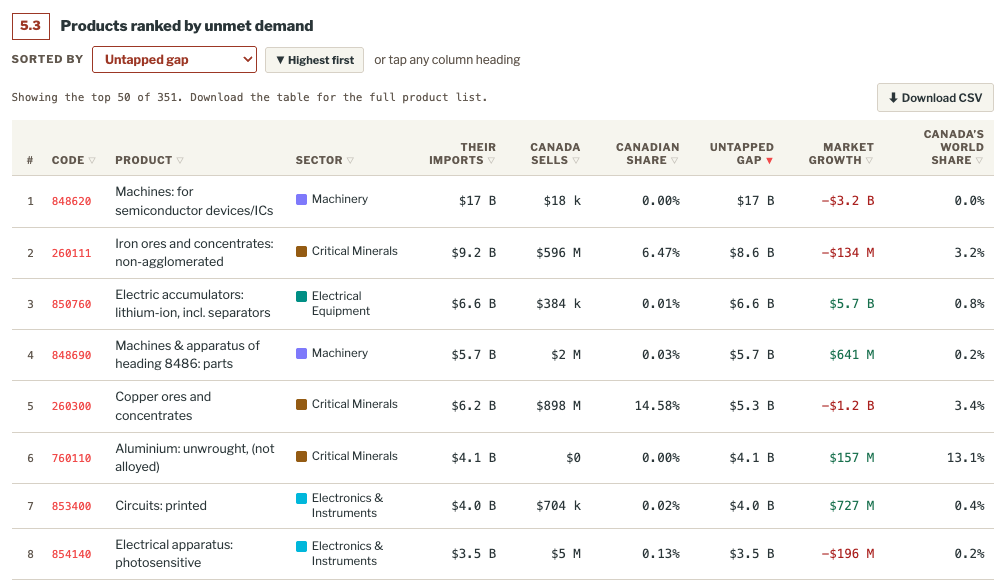
Looking on to Canada’s exports to South Korea of products within the cleantech supply chain, the table indicates that the largest untapped gap is machinery for semiconductor devices. Canada, of course, has essentially no industrial capability in these products as evidenced by next to zero exports to South Korea or even to the world (last column).
Iron ores are the next largest untapped gap, at $8.6 billion in 2024. Here Canada can seek to increase its share of the Korean market from 6 per cent. There may though be competitive headwinds, as the market is shrinking modestly.
Electric lithium-ion accumulators are the third largest untapped gap. Canada’s share of the important and rapidly growing Korean market, comprising $6.6 billion in imports, is a fraction of Canada’s share in world trade. This suggests potential trade diversification and growth opportunities for Canadian exporters which should be examined. As the screenshot indicates, the table can be sorted on any of the columns, and data can be downloaded.
The Explorer helps paint the big picture of allied trade and zero in on potential export opportunities. This should support further assessment of specific producers, product specifications, supply chain relationships, and other relevant factors.
Cultivating opportunities with trade policy and industrial policy working in lockstep
The untapped gaps identified by the Explorer highlight opportunities for Canadian policymakers to align trade diversification and domestic industrial policy.
To compete and displace existing suppliers, Canadian firms must scale up investments in product and process innovation. Product innovation makes firms indispensable to supply chain partners, and able to command higher prices. Process innovation bolsters price competitiveness with global suppliers. Trade liberalization alone will not get firms there – it takes a mix of policy tools to stimulate both the demand-side (procurement, price/offtake stability, regulations, standards) and supply-side (R&D funding, public research infrastructure, skills, tax incentives).
Canada was once better at this. Targeted industrial policy efforts of the 1970s yielded prosperity and growth in oil sands extraction, the satellite industry, and canola (Southin et al. 2025). That changed, however, when Canada started treating industrial policy and trade policy as an either-or proposition (Wolfe, 2015), assuming horizontal tax policy and the competitive pressures of free trade would do the work of scaling Canadian firms in lieu of targeted industrial policy. That shift coincided with the start of Canada’s multi-decade productivity slump.
Our most successful peers took a different path. The US, Taiwan, Korea, and Japan secured leadership in semiconductors, advanced manufacturing and automotive production by running trade and industrial policy in lockstep. Trade liberalization opened markets, while joint industry-government R&D, strategic procurement, intellectual property supports services, export financing and support, and assistance embedding their technology in international standards scaled up firms. In their Centre For Industrial Policy report, Southin et al. (2025) identify three common elements of these successful industrial policies: 1) sustained commitment to a particular technology; 2) ongoing state-industry dialogue to surface the needs of scaling firms; and 3) a policy mix, including trade policy, that adapts to those firms’ needs as they evolve.
Going Further Together: How To Turn Opportunities Into Partnerships
Domestic industrial policy can only go so far. Canada’s odds improve considerably when it aligns with other mid-sized economies in a coordinated effort of collective market formation, scaling up each partner’s supply chain capabilities through joint industrial policy. Three tools stand out:
i. Joint strategic investment: catalytic investment that creates new assets in the allied economies to address supply chain weaknesses.
ii. Pooling procurement: establish common standards and bulk offtakes to derisk new assets or production capacity expansions.
iii. Rerouting supply chains within the alliance: identify and incentivize supply chain relationships amongst members through matchmaking platforms, friendshoring requirements, and other aligned policy measures.
Allies can run long-term joint strategic investment either through a) coordinated deployment of existing national vehicles, or b) a pooled vehicle voting weighted by capital invested (for a potential structure, see here). Pooling reduces transaction costs, increases commitment and lengthens time horizons. It requires more upfront capital, but gives an alliance greater durability and resilience.
Conclusion
The Future Alliance Trade Explorer shows where Canada and its allies can integrate. Whether that integration happens depends on Canada treating trade and industrial policy as one project. A forthcoming Centre for Industrial Policy report by economist Dan Ciuriak will explore how to do this in greater depth.
1 All trade values come from CEPII BACI HS17 V202601, covering 2017–2024.